My primary research focus is on the definition and reuse of system architectures for Digital Twins, design methodology, system design and system of systems. This makes my research lie at the intersection of Digital Twins and Model-Based Systems Engineering (MBSE), with a particular emphasis on the reuse of system models for Digital Twins.
A Digital Twin is a dynamic digital representation of a physical system that connects models, information, and operational data throughout the system lifecycle. Rather than consisting of a single model, it integrates different digital resources to describe the system, assess its current state, predict its future behavior, and support engineering and operational decisions.
Three elements are central to this concept:
Data acquisition: Sensors capture information about the physical system and its operating environment. Depending on the application, some measurements may be supplemented or estimated using virtual sensors, simulations, or model-based analysis.
IT infrastructure: Communication and computing capabilities connect the physical system to its digital representation. Depending on operational needs, data may be transmitted to cloud-based services or processed locally at the system’s edge.
Models: Different models interpret operational data and provide insight into the system. Descriptive models represent its current state, predictive models anticipate future behavior, and prescriptive models support decisions about appropriate actions.
My research focuses particularly on the model-based foundation of Digital Twins. I investigate how system models created during development can serve as a persistent backbone that connects engineering knowledge, discipline-specific models, and operational data. Reusing these models throughout the lifecycle can reduce duplicated engineering effort, support earlier verification and validation, and improve our ability to understand and evaluate the behavior of complex autonomous systems.

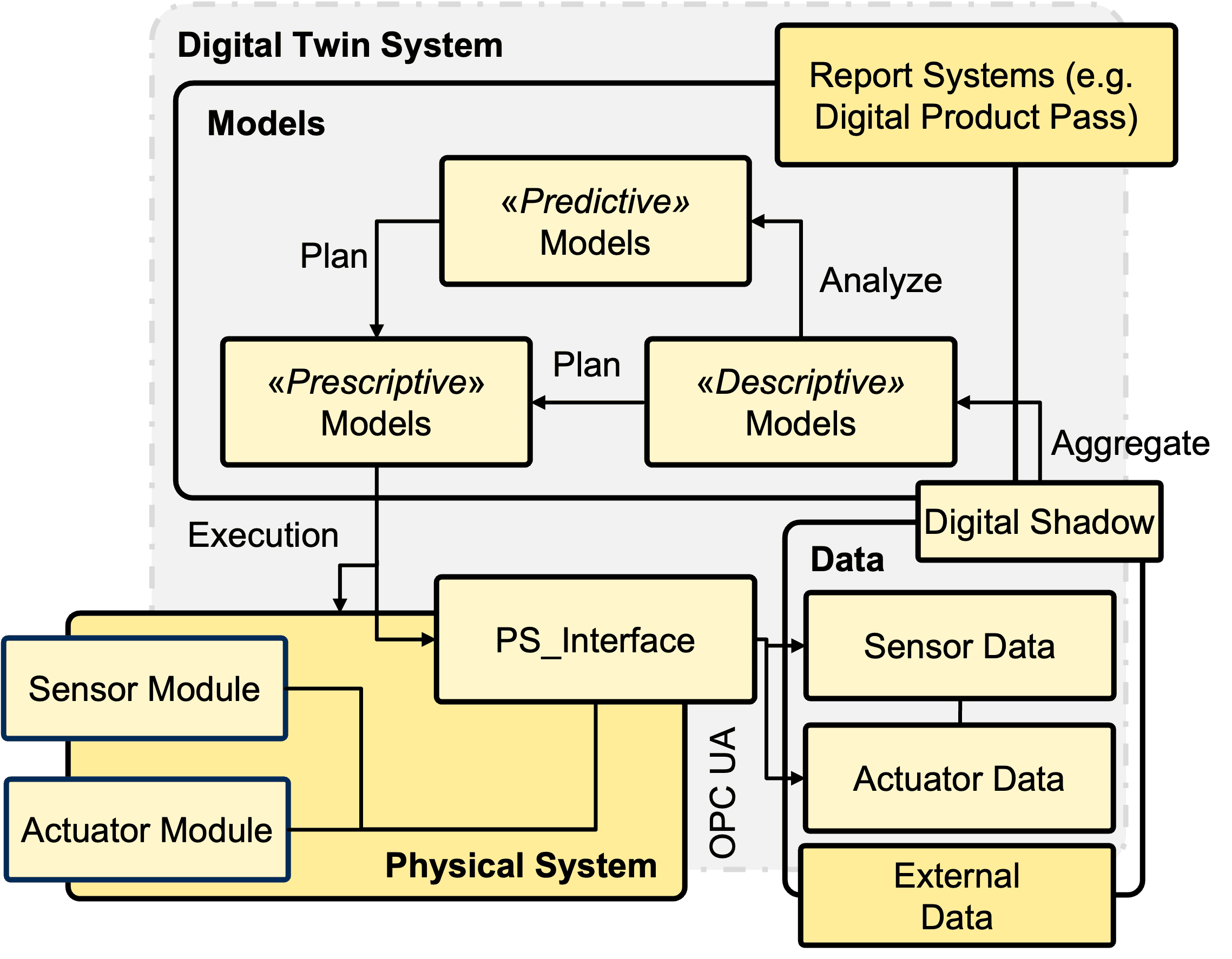
Figure: Definition of the Digital Twin over the Lifecycle
Model-Based Systems Engineering uses integrated system models to describe requirements, architecture, behavior, interfaces, and other aspects of a system. Unlike document-centered approaches, MBSE creates structured and connected engineering information that can be analyzed, exchanged, and reused across disciplines and lifecycle stages.
My research investigates how system models can be designed from the beginning to support purposes beyond their original development context. This reuse and utilization of system models enables engineering information to move both horizontally between disciplines and vertically across the system lifecycle. Models can support a range of applications, including the automated derivation of documents and test cases, generation of executable code, simulation of system behavior, transformation into discipline-specific models, semantic integration of engineering information, and synchronization between connected models.
Preparing models for these purposes requires more than creating a digital version of existing documents. It requires modeling methodologies that consider future applications, information needs, and model connections from the outset. The relationship between the effort required to create and maintain a model and the value generated through its subsequent use must also be considered.
A central objective of my work is to use system models as the foundation for Digital Twins. System models can provide descriptive representations of a system’s architecture and current state while also supporting prescriptive models that inform engineering and operational decisions. By connecting these models with domain-specific analyses and operational data, MBSE can establish a persistent model backbone that supports verification, validation, decision-making, and system evolution throughout the lifecycle.

Figure: Systems Engineering V-Model showcasing the reuse of System Models for the Digital Twin.
Unmanned Surface Vessels provide a compelling application area for my research on Model-Based Systems Engineering and Digital Twins. Their growing autonomous capabilities require the integration of sensors, software, communication systems, and mission-specific payloads into increasingly complex system architectures. My research investigates how system models and Digital Twins can support this integration, enable the exploration of new mission capabilities, and connect engineering knowledge with operational data.
A particular focus is the integration of new sensors and the use of their data to understand, evaluate, and improve system behavior throughout the lifecycle. These capabilities are especially relevant in contested maritime environments, where reliable communication and continuous human control cannot always be assumed. System models and Digital Twins can provide a foundation for evaluating how autonomous systems perceive their environment, respond to uncertainty, and continue to support mission objectives under degraded or changing conditions.
Through this work, I seek to advance the development, verification, and integration of capable and trustworthy autonomous maritime systems. USVs provide an operationally relevant platform for studying how MBSE, Digital Twins, and sensor-enabled autonomy can contribute to future naval capabilities and critical missions.

Figure: CONOPS for Digital Twins of USVs.